

Icebreaker Activities to Spark Creativity
Icebreaker activities are vital components of successful corporate retreats, serving as the foundation for effective team building and sparking creative thinking among participants. By engaging employees in light-hearted yet purposeful exercises, these activities help dismantle social barriers that can hinder collaboration in a typical office environment.
One standout example is the Story Chain game, where team members build a collective story one sentence at a time. This fosters creative thinking as individuals must think on their feet and incorporate unexpected elements. It also enhances team building by requiring active listening and mutual support throughout the session.
Another fun option includes improv workshops tailored for corporate groups. These sessions encourage spontaneous interaction, breaking down walls and promoting a sense of camaraderie. As employees improvise together, they develop skills in creative thinking that translate directly to innovative problem-solving back at work during corporate retreats.
Collaborative drawing challenges provide a visual twist to icebreaker activities. Groups might create a large-scale artwork representing their company’s future vision. Such experiences not only boost team building but also stimulate creative thinking through the exchange of diverse perspectives and shared creative energy.
Role-playing scenarios based on real business challenges can be both entertaining and enlightening. Participants assume different roles to explore solutions creatively, which strengthens bonds and encourages out-of-the-box ideas. Mystery-solving games similarly promote team building while challenging participants to apply creative thinking in a fun context at corporate retreats.
Additionally, incorporating music or movement-based icebreaker activities can energize the group. Dancing or rhythm exercises not only break the ice but also open minds to new forms of creative expression and collaboration. Overall, integrating well-chosen icebreaker activities ensures that corporate retreats are memorable and productive, leaving teams more cohesive and inspired.
Collaborative Brainstorming Workshops
Collaborative brainstorming workshops are vital for fostering innovation in corporate settings. These sessions utilize group brainstorming techniques to drive idea generation and strengthen collaboration among team members. By participating in well-organized creative sessions, employees can unlock their creative potential and address complex problems with fresh perspectives.
Structured formats play a key role in the success of these workshops. Facilitators introduce methods like brainstorming with constraints or reverse brainstorming to stimulate thinking. This structured guidance prevents chaos while encouraging free expression of ideas, leading to higher quality outputs from the collaboration.
The benefits extend beyond immediate idea generation. Attendees develop enhanced creative problem-solving skills that they apply back in the workplace. Collaboration becomes second nature as teams learn to value diverse inputs and build upon them constructively during the creative sessions.
To ensure effectiveness, workshops include breaks for reflection and individual contemplation before group discussions resume. This balance allows for both personal insight and collective refinement of concepts. Ultimately, such activities transform corporate retreats into catalysts for sustained organizational creativity and teamwork.
Companies report significant improvements in project innovation after implementing regular brainstorming workshops. The focus on collaboration helps in aligning team goals and generating ideas that are both practical and groundbreaking. Creative sessions like these are investments that yield long-term returns in employee satisfaction and business growth.
In conclusion, integrating these elements ensures that brainstorming workshops deliver on their promise of inspiring creative thinking. Through deliberate practice of idea generation and collaboration, participants leave with actionable skills and renewed enthusiasm for tackling future challenges.
Art and Design Thinking Sessions
In the dynamic landscape of corporate retreats, Art and Design Thinking Sessions emerge as essential components for fostering creative thinking. These carefully curated experiences integrate art activities with proven design thinking frameworks to unlock innovative potential among team members. Participants engage in various art activities, including free-form painting and three-dimensional modeling, which serve to dismantle mental blocks and encourage novel idea generation.
Chad Littlefield: 5 No-Prep Icebreakers For Adults

The application of design thinking in these settings involves guiding attendees through empathy mapping and rapid prototyping exercises. This structured yet flexible process inspires out-of-the-box thinking by focusing on human-centered solutions. Innovation workshops built on these principles allow companies to address complex issues in imaginative ways, often resulting in unique business strategies.
Creative exercises play a pivotal role, such as group improvisation sessions or visual brainstorming with sticky notes and markers. These methods not only enhance collaboration but also translate artistic insights into actionable plans. Teams discover how to iterate on ideas quickly, much like designers refining prototypes based on feedback.
Furthermore, the inclusion of these sessions in retreats promotes long-term benefits, including improved team dynamics and a sustained emphasis on innovation. By participating in design thinking and art activities, employees return equipped with new tools for tackling challenges creatively. Innovation workshops of this nature demonstrate that blending art with methodology can lead to significant advancements in corporate performance and employee engagement.
To maximize impact, facilitators often tailor activities to align with specific company goals, ensuring relevance and applicability. This personalized approach maximizes the value derived from creative exercises and design thinking practices.
Outdoor Adventure Challenges
Stepping away from the confines of the office, outdoor challenges offer corporate teams a unique platform to enhance their collaborative skills. By participating in adventure activities such as rope courses and wilderness navigation, employees are encouraged to engage in problem solving in dynamic, unpredictable settings. This shift to a natural environment stimulates fresh perspectives, directly boosting team creativity as groups must devise innovative strategies to overcome hurdles together.
The physical demands of these outdoor challenges require participants to communicate effectively and support one another, mirroring the dynamics needed for successful project management back at work. Adventure activities like team-based orienteering or building temporary shelters from natural materials highlight how creative thinking emerges when comfort zones are left behind. In this way, problem solving becomes a shared adventure that strengthens bonds and inspires novel ideas.
Furthermore, the serene backdrop of nature allows for deeper reflection during these experiences. Teams often find that outdoor challenges not only test physical endurance but also unlock latent creative potentials through collective brainstorming under the open sky. Adventure activities designed with elements of surprise and adaptation promote resilience and ingenuity, essential traits for any forward-thinking organization.
Moreover, these activities help in breaking down hierarchical barriers as everyone contributes equally to finding solutions. Whether it is scaling a rock wall or solving puzzles in the forest, the shared experiences create lasting memories that translate into better workplace interactions and increased innovative output.
In conclusion, the integration of physical outdoor elements into corporate retreats proves invaluable for inspiring creative thinking. By immersing teams in adventure activities, companies can cultivate an environment ripe for problem solving and enhanced team creativity that persists long after the event concludes.
Reflection and Idea Sharing Activities
Reflection exercises are key to helping employees digest the experiences from the corporate retreat. These reflection exercises might consist of writing prompts that ask participants to note three creative ideas they encountered, or pair discussions where they exchange reflections on what inspired them most. Through these methods, team members develop a deeper understanding of how the retreat activities have enhanced their creative thinking abilities and prepared them for subsequent sharing phases.
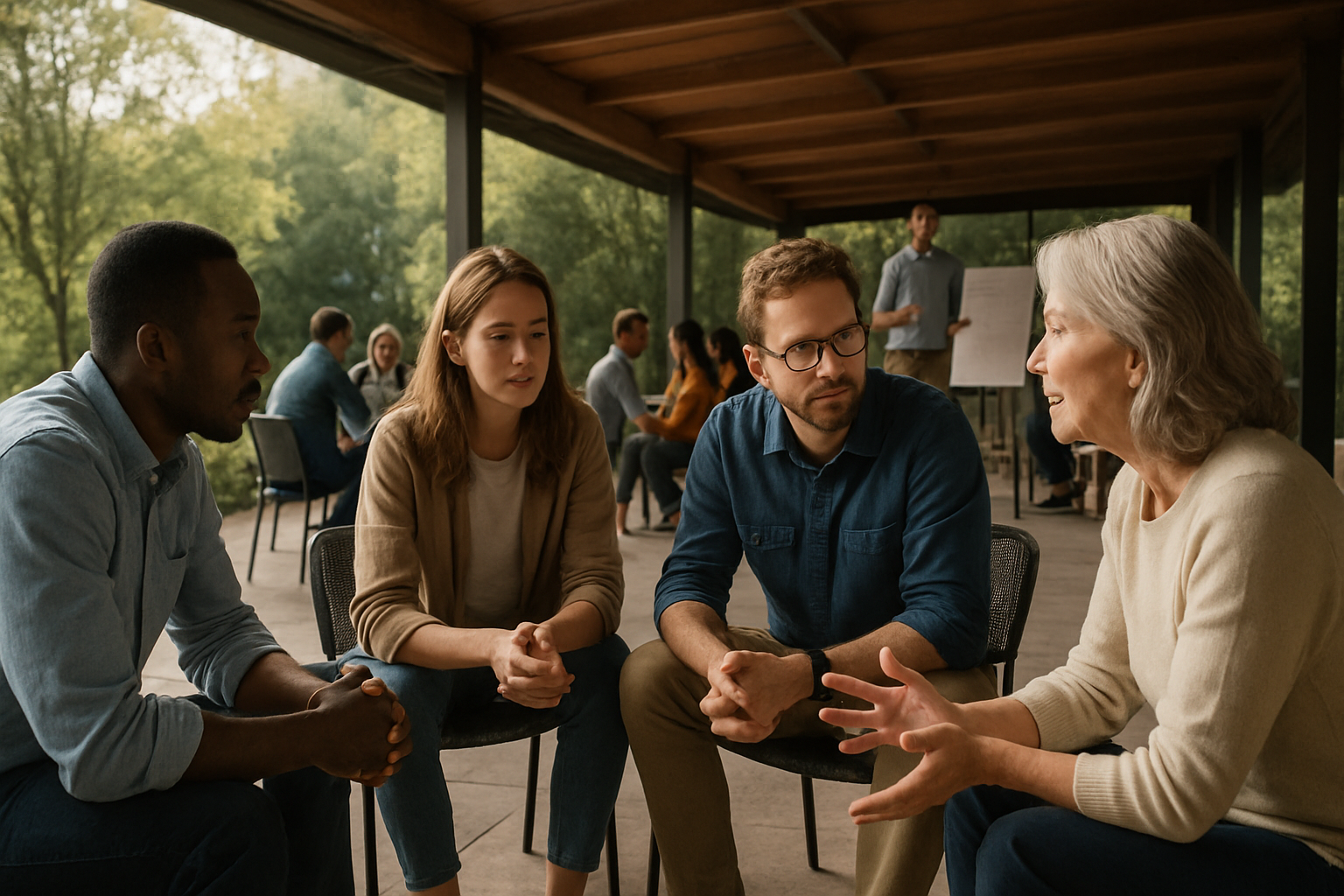
Following the reflection period, idea presentations become central to the agenda. In idea presentations, groups or individuals stand before their peers to describe and illustrate the creative ideas they have formulated. Using tools like whiteboards, digital slides, or even short skits, presenters can effectively communicate their visions, garnering interest and excitement from the audience while highlighting the innovative spirit fostered by the retreat.
Feedback sessions then play a pivotal role in polishing these concepts. Organized feedback sessions allow for round-table discussions where attendees provide balanced input on the strengths and potential enhancements of each idea. This collaborative feedback not only improves the quality of the proposals but also empowers participants with new perspectives, ensuring that the ideas are robust and ready for practical application.
By weaving together reflection exercises, idea presentations, and feedback sessions, the retreat paves the way for meaningful creative outcomes. These creative outcomes extend the value of the event into everyday work life, promoting a culture where creativity thrives. The lasting impact on the team is evident in improved problem-solving skills and a shared commitment to innovation that continues long after the retreat ends.

I love spotting the intersection between business strategy and travel experiences. When I’m not planning my next trip, I enjoy writing about how entrepreneurs can turn journeys into growth opportunities.